On Mondays We Wear a Red Scarf
By Alicia Lou
July 26, 2000
Called the private school in Beijing today, where I am thinking of sending Alicia to. I know it’ll be good for her, but at the same time I feel very reluctant to let her go because I feel so close to her…
***
I was 7 years old when my mother left me at a boarding school in Beijing (北京, Bêijīng).
Before I was left in China, I don’t think I ever thought about being Chinese. Sure, we saved every plastic bag we ever used, we never had actual cookies in the blue Danish cookie tin, my parents spoke Mandarin at home, and every so often my mother would tell me to do something a certain way “because that’s how Chinese people do it,” but I never considered what that meant. I didn’t feel proud to be Chinese, I didn’t feel ashamed, I didn’t feel anything about it. I was born in Reno, Nevada, and I grew up in the suburbs of Albany, New York. My two best friends were Ariel and Hailey, and I never realized that I looked nothing like them.
In 1997, my family moved to Hong Kong for my mother’s work. My brother and I enrolled at a private British school. He started his last year of junior high while I was in the second grade. His uniform was a white short-sleeve dress-shirt with navy pants, and mine was a red and white pinstripe dress with a choir boy collar. Alex and I shared a room and a bunk bed, and we lived on the 32nd floor—a detail I’ve never forgotten since the night the power was out and we climbed up the stairs in the dark. Life was not perfect, but most days, I was a happy little girl.
The last thing I remember learning about at the British school was Egyptian history in the third grade. I dedicated the better part of my weekend coloring in an A3-sized printout of King Tutankhamun’s funerary mask. I asked my mother for the fancy gold markers from the stationery store near our apartment, the kind with a small metal ball inside that had a strong, chemical smell, one that you had to shake vigorously every so often while using. It took at least two or three fancy gold markers to color the mask in its entirety and I was quite proud of how realistic my mask looked. The other kids used yellows and oranges to compensate for gold, and a few of them completely free-styled their palette, producing hot pink and green and blue King Tuts. My teacher, Mrs. O’Neil, held up my notebook to show the rest of the class. I beamed as she praised my work, and I pretended it wasn’t the best thing to ever happen to me.
One day, my mother wrote a letter to Mrs. O’Neil explaining that I would be absent the following week. In typical Chinese mother fashion, she also asked for any homework I would miss, reassuring my teacher that she’d make sure I’d turn it in on time. I remember because I’m nosy and I read the letter before I delivered it.
My mother told me we were going to Beijing to tour a school that her friend recommended and was considering for her daughter, who was a year and a half older than me. She was vague about why we were touring the school but I didn’t think to question her motivation. I was excited that I got to skip school and I liked to go on planes. She said I could attend the school in Beijing if I wanted to.
On the flight over, my mother and I had a row of three seats to ourselves. She sat by the aisle, lifted both armrests on the middle seat, and put a pillow on her lap for me to lie down on. As she combed my hair with her fingers, I looked out the window as we poked through a cluster of fluffy clouds, keeping an eye out for heaven and any dead relatives that might be floating about—a private ritual I started after the first plane ride I remember taking. I thought about my friends at school, Mrs. O’Neil, the Nile, the many treasures King Tut was buried with, and Howard Carter, the archaeologist that discovered Tut’s tomb. I loved that learning always meant arts and crafts, construction paper in every color and PVA glue on our fingers. I loved sitting crisscross on the carpet on Monday mornings talking about what everyone did on the weekend, and I loved to play games and trade snacks with my classmates. I loved wearing headbands and bows in my hair and socks with frilly ruffles; I even loved my candy-cane-looking uniform dress, and the itchy gray cardigan it came with. Bursting with fondness for the life I knew so far, I looked up at my mother and said, “Mom, I don’t care how nice the school in Beijing is. I’m going to miss my school and my friends so I don’t want to go to a new school. Okay?”
“We’ll see.”
***
We didn’t go to the boarding school right away. It was my first time in Beijing and my mother’s first time back in over a decade. She showed me around, and in between the touristy things we did, I earnestly continued to chisel away at my homework for Mrs. O’Neil. We saw Tiananmen Square; I did my math homework. My mother took me to the building she used to work at as a journalist in her 20s; I practiced my cursive writing. We ate our weight in zhájiàngmiàn (炸酱面, “fried sauce noodles”) and dumplings, then one day she took me to meet an old couple. My mother told me to call them grandpa and grandma, yéyé (爷爷) and năinai (奶奶), though they weren’t related to us in any way. Sòngnăinai (宋奶奶) was a general in the army, and my father met her almost two decades ago when he was a soldier. Her voice was sweet like honey, though I didn’t understand much of what she was saying. Wángyéyé (王爷爷) had a strong accent so I especially couldn’t understand what he was saying, but he smiled a lot and had a calming presence, like sitting under an oak tree on a sunny day. I didn’t know it yet, but I’d be spending my weekends with them.
The day before we went to the school, my mother took me to get my hair cut. I had beautiful, thick, long, jet-black hair that almost reached the small of my back, and it was all one length, like the hair that the Disney version of Pocahontas had. Somehow, I agreed to have it all chopped off. What’s even more peculiar was that I was thrilled about it; the idea of a hair salon was exciting and so was a new hairstyle, mostly because I didn’t know how long it took hair to grow. When the stylist was done, my hair was so short that it didn’t even cover my neck. I looked in the mirror and didn’t recognize myself. I felt like one of my Barbies that I had carelessly taken a pair of scissors to. I looked like a boy. But my mother seemed pleased; having long hair was distracting and fussy, and without it I had more time to focus on things that mattered—like my grades.
My hair never grew back the same.
***
August 29, 2000
The school is extremely spacious and has impressed me with its very well organized facilities and professional security guards. But I won’t be able to afford it if they charge us as a foreign student. The teachers here are very friendly, I hope something can be worked out.
Alicia already starts to miss her dad.
Beijing has really changed! I could hardly recognized the place! Song Ganshi’s son took me to Tsinghua to meet with Wu, but because the place Wu took me would not take me, I decided to come to Song’s home. After all I wanted Alicia to be able to learn to speak more Chinese and Song’s both grandchildren are here. The three of them already got along. If I stay outside, they would come to pick up Alicia everyday and take her to me in the evening, which would be a lot of trouble. Song and her whole family are really nice to us.
Will go to Tsinghua tomorrow morning. Hope to get things done quickly.
August 30, 2000
Took Alicia for the exam in the morning. She only did the math part and needed help with the problems. Based on the results, she could only qualify for the Grade 1. However, I talked to them and asked them to let her start with the second Grade. I also talked to the class teacher. She seemed to be very nice, too.
Alicia cried most of the time after she finished the exam, but all the teachers were very supportive and patient. She said she did not want to go to that school at first.
Called Jeff at night. I was very disappointed that he still did not find his ticket. People all lose things from time to time, but he does not have a good solid reason and does not have a sense of responsibility at all because he has put everyone into blame except himself. If he remains that way, he is totally helpless.
The morning after I had my hair chopped off, we had congee for breakfast then got in a taxi to head over to the school. Taxis in Beijing seemed to perpetually reek of cigarettes, even if the driver had the decency to not smoke when we were in the car, which wasn’t always the case. I was familiar with this smell because my dad was a smoker, even though he was constantly trying to quit. On the ride over, I watched as the buildings slowly started to thin out. They became more modest, and the further we drove the shorter they got. Eventually, there were only endless rows of trees and farmland. Then I started to notice a wall, not yet realizing I was looking at the border of the school. Before I learned about car crashes, I felt like nothing bad could ever happen to me in a car. The idea of everyone and everything I cared about most being together all at once in a small space was deeply appealing to me and I loved car rides. Though they always felt like they were going to last forever and then ended abruptly—we were here. The taxi driver pulled up to the front of a metal gate and let us out. There were two or three guards in pine-green uniforms and matching caps standing on either side of the metal gate, each group outside their own little office that looked like a toll booth. A few of them were smoking. They walked around as if they were carrying guns. I wasn’t sure if they were there to control us or protect us.
The campus was enormous. I felt hopelessly small. Past the metal gate there was the greenest, neatest field of grass I had ever seen, surrounded by a bunch of buildings. The one closest to the gate was the tallest one, the ones on the left and right looked the same as each other, those three were a boring beige color, the one directly across the field was covered in what looked like dozens of mirrors and there was a big staircase that led up to it. I didn’t see anyone walking around or playing in the field. I thought the school was closed and was secretly delighted that we’d have to go home but then a lady came to greet us.
I hid behind my mother as they shook hands. We started walking on the pavement around the field. The lady would say something and every now and then my mother would translate. We walked up the stairs to the building with the mirrors, she told us this was where assemblies and school performances took place. We walked down a different set of stairs on the other side, by the art and music building, and onto a track field that was bigger than my entire school back home. The lady said the sports building behind the track has an indoor heated pool and different types of courts. The sports building seemed really new, like the last layer of paint had just finished drying.
We left the track and stood in what felt like the center of the school. The lady pointed to the teacher and student dorms, and mentioned a guest hotel with a mini mart where students could buy things with credits if their parents left them money in an account. There were also two cafeterias, and a guest dining hall which we were walking toward to have an early dinner.
The dining hall was noticeably nicer than the cafeterias. It was surrounded by greenery and had a small fishpond in the front with a little bridge. A makeshift oasis from the rest of the school. The lady ordered a bunch of dishes for the table and smiled at me. This was always how Chinese people ate, and it was also how they wooed. A plethora of food on the table is a communal love language; I understood this, even though I couldn’t speak to her since I only spoke English and she only spoke Mandarin. Mandarin felt both foreign and familiar to me. It was technically my first language, but English quickly took over after I started going to daycare in the States. Apart from knowing how to count to ten, and the words for: ‘me,’ ‘him,’ ‘her,’ ‘mom,’ ‘dad,’ ‘older brother,’ ‘thank you,’ and ‘don’t want,’ there wasn’t much else I could say. I sat there shoveling food back and forth while my mother chatted with her, quietly thinking about flying home the next day and seeing my friends.
My mother was thoroughly impressed. The lady didn’t need a table of food to woo her. I could not be swayed. I didn’t like running and I didn’t like swim class. It was all too modern. Too gray. Pointy, somehow. I loved my little school and I didn’t care how big or fancy this other school was, but I politely agreed that it looked nice. I could not imagine living away from my family five nights a week, the way the kids did here. Some of them even lived at school for the entire semester because their families were too far away. I felt sorry for them.
“You would do well at a school like this, Mingming,” my mother said.
But she was always saying things she didn’t mean. She said we could get a dog if I was a good girl, or that we could get a dog once she finished her Ph.D., that she would stop working so much and have more time to play. We remained dog-less and she continued to work as much as she could. I had no reason to think that when she said she thought I’d do well here—she really meant it.
After dinner, we left the dining hall and said goodbye to the lady. My mother and I began making our way to the guest hotel. We passed by the student dorms. When we got to a building in the second row, my mother suggested that I should sleep there.
“Just for a night, just to experience it,” she said.
After the haircut incident, I didn’t really want to have more new experiences, but I wasn’t used to disobeying my mother. After some convincing, I obliged and begrudgingly climbed up the stairs with her. She led me to the third floor, first room on the right. I could smell the bathroom as I walked past it. The dorm had white walls, off-white tiled floors, and eight beds. It looked the way I imagined a hospital would look and I immediately hated it.
No one else was in the room when we got there, and my mother told me to take the bed closest to the door. Each of the beds had a white mosquito net that hung from the ceiling. The nets were pretty, something like a Disney princess would have. I had no idea what they were actually for.
All the other girls had slippers neatly placed at the sides of their beds, and all eight headrests pushed up against two opposing walls, leaving an empty space in the middle of the room. Four armoires made a makeshift wall on the right side of the room, the side of the armoire was the first thing you saw when you walked in. All the furniture was painted in a metallic and grainy-looking pale teal, and it felt the way it looked, rough and scratchy to touch, like sandpaper. One small mirror hung on the wall; a circle just big enough to see your face.
I half-heartedly draped my net over the bed and didn’t tuck in the ends. I brought half a suitcase of stuffed animals from home and I arranged them all around my head. My mother said goodnight, turned the light off and left.
I pretended to be asleep when the girls got back to avoid any interaction. I’d be gone tomorrow, or so I thought.
Sept 5, 2000
I am leaving without talking to Alicia, but I talked to her teachers. I am so grateful that she has such a mother-like teacher and feel totally assured that she is in good hands. I am sad, but also happy that she is taken good care of and is going to learn a lot of wonderful things.
I am now on my way to Hong Kong. I have to make sure that Alex and I make the best use of the time that Alicia’s absence gives us and do our things well. Only by that way, will I be able to justify my decision to let her stay separate from me. She kept reminding me yesterday that I had told her that we would always be together. Yes, although I am physically away from her, I will always be thinking of her… She will also be thinking of me…
***
“起床了,起床了。睡醒了吗?”
Get up, get up. Are you awake?
“我不要。我妈妈在哪里?”
I don’t want to. Where’s my mom?
“你妈妈回家了!她已经走了。你现在就住在这里,好吗?来吧,起床吧,你要迟到了!”
Your mom went home. She already left. You’re going to live here now, Okay?
Come on, get up, you’re going to be late!
I jolted awake to what sounded like a fire alarm blaring above me, but I was still sleepy. I kept my eyes shut and tried to ignore it, the way a guilty dog shuts his eyes when confronted about the torn-up couch or the tipped-over garbage can. It was 6 a.m., and like most 7-year-olds I wasn’t accustomed to waking up at dawn. I was covered in sweat and mosquito bites.
A woman I had never seen before was telling me to get out of bed.
She lifted the untucked net and got under it, her face inches away from mine as she shook me awake with both hands. I wasn’t used to someone who wasn’t my mother in my personal space. I didn’t like it and I started crying, loudly, void of any shame. I knew something was terribly wrong even before I was told my mother left when I was sleeping. It felt like the time I got lost at a mall and couldn’t find my mother, except now I was stuck at the mall and she had left me there on purpose.
The other girls graciously ignored me. They were already making their beds, gathering and tying up the ends of their mosquito nets, folding their duvets into perfect little books and stacking their pillows on top of them, placing both against the metal bars of the headboard.
I saw a plastic mug that matched everyone else’s and a toothbrush and toothpaste on my nightstand. I couldn’t stop crying. The world around me continued as I kept still.
The other girls were now changing into a uniform. I took one look at their clothes—at least I didn’t have to wear that. I hated skirts. I would just wear the clothes I wore yesterday. The woman then appeared with a stack of uniforms. She handed them to me and was called away. Everything was already marked with my name and room number. She gave me five skirts, three blue and two green, five white shirts, three with blue lining around the collar and two with green lining, and one red square which I would soon discover was a scarf.
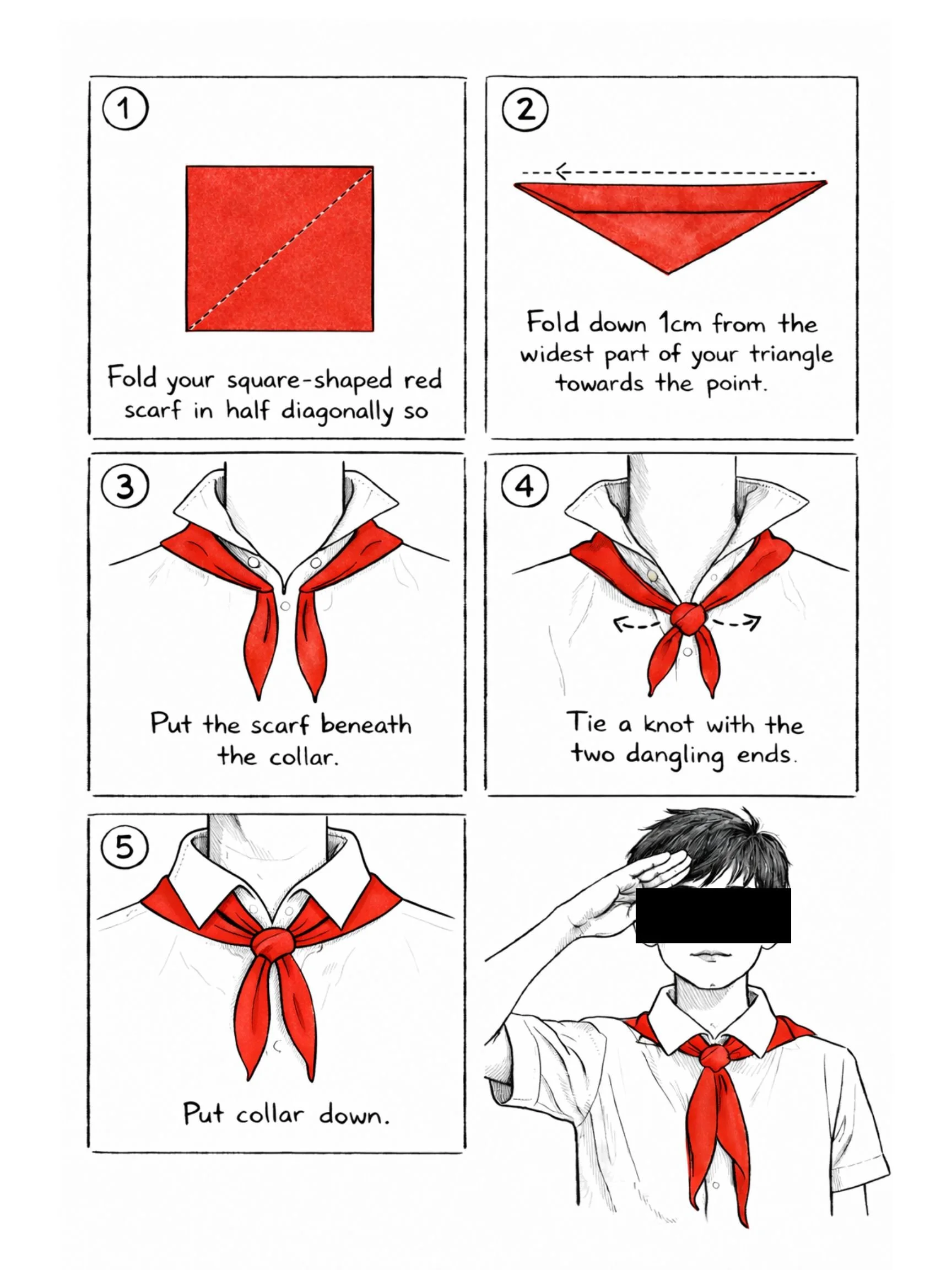
This particular scarf worn by most Chinese schoolchildren is literally called a red scarf in Mandarin (红领巾, hóng lǐng jīn). The red scarf is a symbol of the Young Pioneers of China, a youth group founded by the Chinese Communist Party in 1949, according to The Children’s Bigrade. The square is folded in half diagonally to form a triangle, then, without touching the point, folded once or twice horizontally for neatness. It’s worn around the neck with a loose knot in front and a small triangle visible in the back, pointing downward. The red scarf represents commitment to socialist and communist values and dedication to the country and its ideals. I can’t recall being told any of this at the time; I just wore one because I had to.
Still in my own clothing, I followed the other girls holding their toiletries as they made their way to the communal bathroom. At home, I walked around barefoot, always leaving behind the pair of slippers my mother asked me to wear over and over again. Here, I quickly realized why the other girls wore slippers when I stepped in a puddle of water as soon as I got to the sink.
The bathroom was just two rows of deep and narrow washbasins on either side, each with five spouts. There were no mirrors and it was unnervingly dark, which somehow made The Smell stronger. A door through the sink area led to four stalls with squat toilets[1], which I had never used or seen or heard of or smelled before this. One other room of eight girls shared this bathroom, and another bathroom just like it was on the other side of the hall for two other rooms of girls. We shared one large shower room which had at least ten or twelve shower heads and no shower curtains. The first night I showered I wished, hopelessly, that I could hide behind my hair.
When I got back to the room, I plopped down on my bed and watched as the other girls lined up by the door. The woman came back and started talking at me again, holding up the blue uniform set. She stood in front of me, waiting, as I awkwardly undressed in front of her and put the uniform on. She folded the red square and put it around my neck, under my collar, and tied it for me.
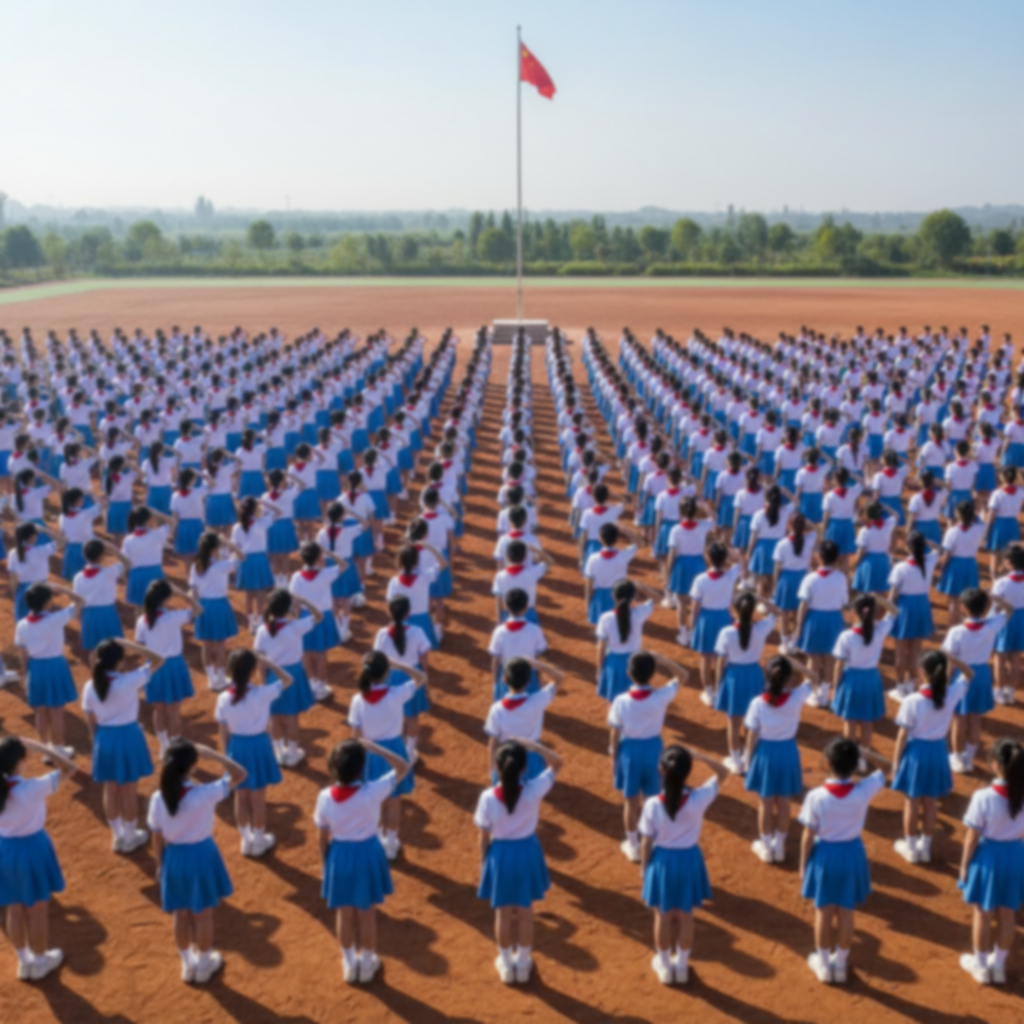
That Monday morning, everyone gathered on two separate fields and formed neat, orderly rows to watch China’s flag being hoisted into the air before the day commenced.
We had to salute the flag as it rose, and the Chinese national anthem played through a horribly cheap speaker that made my ears hurt when it tried to produce a certain pitch, probably because it was turned up all the way so the people on the other field could hear it, too. There were four classes in each of the six grades in primary school, and about thirty kids in each class. Grades one through six on one field while the high school students were on another. If you didn’t have your scarf you weren’t allowed to stand with your classmates, and repeat offenders wound up in detention. I had no clue what they were singing. Even when I eventually learned the words and sang along, I never fully understood what they meant. To me, it was just noise.
It still is.
[1] If you also haven’t heard of or seen or smelled one before, squat toilets in China typically do not have a water seal, which means the waste goes into a basic drainage system instead of going directly into a sealed sewer. Without a water seal, the gases from the sewer, such as methane, can (and they do) come up through the drain, which is one of the several reasons it has a god-awful smell—a smell that I brushed my teeth next to for the next three years.
***
China’s National Anthem, composed by Tian Han, 1934
义勇军进行曲, Yìyǒngjūn Jìnxíngqǔ, March of the Volunteers
起来!不愿做奴隶的人们!
Arise, ye who refuse to be slaves!
把我们的血肉,筑成我们新的长城!
With our flesh and blood, let us build a new Great Wall!
中华民族到了最危险的时候,
As the Chinese nation faces its greatest peril,
每个人被迫着发出最后的吼声。
All forcefully expend their last cries.
起来! 起来! 起来!
Arise! Arise! Arise!
我们万众一心!
Millions of hearts with one mind!
冒着敌人的炮火,前进!
Brave the enemy’s gunfire, march on!
冒着敌人的炮火,前进!
Brave the enemy’s gunfire, march on!
前进! 前进!
March on! March on!
进!
On!