On Becoming
By Alicia Lou
April 5
[1996]
It almost hurts to see how sensitive little Alicia is. She was telling me how she wants to sleep with me even when she grows up (she has been sleeping w/ me), Alex corrected her, saying that when you grow up mom would no longer be there. Alicia started crying and asked where I was going to. Alex said mom would die. That really scared her. Ever since then, almost every day, she would say “mom, Alex was just joking, you won’t die” or “mom, I don’t want you to die” or “mom, I want to be with you forever.” And she would be in tears when she says that. I told her every person dies at a certain age but that won’t happen to mom for a long time.
She is so perceptive. I could see how she could be hurt if not guided properly. Fortunately, our family came out of the miserable year intact and their daddy has been their nice dear daddy again.
As a child, I was unusually quiet with a tireless imagination, which meant that being alone never really bothered me. I enjoyed my own company and preferred it to being around people I didn’t like or people that bored me, which is still true. I drew, I colored, I played dress-up, I watched the same movies we had on VHS over and over again and never got tired of them: Pocahontas, Mr. Holland’s Opus, The Lion King, 101 Dalmatians, and Mrs. Doubtfire, all of which had been given to us. I had hand-me-down teddy bears galore but my two favorite toys were ones that were bought for me—a large fish-shaped pillow my Grandma Joan gave me for my 5th birthday, the last time I saw her alive, and a hippo I picked out for myself as my Chinese New Year gift (the closest thing Chinese people have to Christmas). I played princess, shipwreck rescue missions inspired by Tintin, hosted family meals and fashion shows with my stuffed animals and knock-off Barbie dolls, some of which had wonky eyes and truly awful haircuts thanks to me. After I saw the dollhouse the girl that lived downstairs got for her birthday, my dad helped me make one out of shoeboxes. I made furniture with the scraps, and subsequently played many games of house.
Though it’s true that I had no trouble entertaining myself, it was generally conditional to my mother being nearby, or at least knowing where she was. Each time she prepared to leave for her long work trips, I would somehow get the idea that her plane would crash, so I would beg her to not go and then cry myself to sleep when she left anyway. I was a little over 8 months old the first time we were separated (more on that later). When I was 6 years old she left me in Hong Kong with my grandparents when she had to go back to the States; I couldn’t speak Chinese and especially couldn’t understand their dialect, and they couldn’t speak English, so even though they cared for me I felt like they were strangers. My grandmother was so fed up with me asking to call my mother all the time that she held up a pair of scissors to the phone line and threatened to cut it if I didn’t stop crying. I locked myself in my room and refused to eat.
Since my mother didn’t believe in paying for babysitters, both my brother and I were often left alone. Sometimes, I’d go to her office and kept myself busy while she worked. At home, she’d be down the hall in her study, and for the most part, I knew well enough not to bother her. Once in a while, after a few hours by myself I’d suddenly wonder what my mother was doing, realizing I hadn’t seen or heard from her in a while.
“Mom?” I called out from my room. I didn’t necessarily even want anything from her, I just wanted to hear her voice or know she was there. If she didn’t answer I’d call again and again and finally get up and go looking for her.
“MOM, where are you?”
There was one afternoon she didn’t answer for a good ten minutes because she was outside, hanging up our laundry. When she came back in I told her that she scared me. She then said that one day she wouldn’t be able to answer me because she would “no longer be here.”
“Mama won’t always be here for you,” she said in Mandarin, in case I missed it the first time. I cried. It wasn’t the first or last time she would remind me that I was going to outlive her. My mother still often casually mentions her mortality. I think she thinks by doing so she is preparing me for her inevitable death and doing me a favor. My mother is alive and mostly well, yet I miss her the way I miss being 3 years old, perched on her office table while she worked, the way she brushed my hair, when I was small enough to be held in her lap. I miss her the way I miss my favorite red jacket, the one with brown toggles that hung in the closest of my childhood home, where we lived as a family of four. Neither the jacket or that version of our family could ever be retrieved.
My attitude towards her changed as I got older, and to her dismay, after I left for college there were months and even years of little to no communication between us and she never understood why.
“How did I raise such a daughter? Do you ever think of your own mother?” she’d ask.
The truth is that for many years, I didn’t think about her. Up until my late 20s to early 30s, there was a part of me that deeply resented my mother for abandoning me over and over again. My forgiveness and acceptance of what she did, did not happen in one sweeping moment. As I got older, every emotion I felt slow burned and fizzled into nothing. I was able to truly let it go only when I fully understood that she did the best she could with what she was given. I know that now—people can only show up for you as they are, even if it’s not what you want or need—and parents are just people, they are not faultless gods.
To attempt to understand my mother, you must first know how she became who she is.
My mother is the oldest of three daughters. Her father, my wàigōng (外公), lost both his parents when he was 7 years old. I don’t know how his mother died, but his father was attacked by a dog and they were too poor to seek medical help, so his wounds became infected and soon they were fatal. Wàigōng was raised by his older brother, he joined the Chinese Communist Party when he was 20 years old and became a driver for CCP officials until he retired in 1989. My grandmother, my wàipó’s (外婆) parents lived a longer life, but during a time when most of China was ravished by poverty, so it just means that their suffering was prolonged. My mother recalls my great-grandfather often complaining of stomachaches, which turned out to be stomach cancer. My mother said that “he literally ached to death.” Wàipó’s mother beat her frequently, which led to their estrangement after Wàipó’s father died. Wàipó started working at a young age, cleaning and cooking for the men that worked with Wàigōng, which is how they met. They married in 1954, when Wàigōng was 27 and Wàipó was 19 years old. By the time they had my mother in 1956, Wàipó was working in a hemp textile factory, where she worked until her retirement in the late 90s.
My mother was 2 when Máozédōng (毛泽东), the leader of China at the time, launched a social and economic campaign in 1958, a four-year-plan he called “The Great Leap Forward,” peddled with the slogans that China will “surpass Britain and catch up with America,” that with “grain as the key link,” if Chinese people “work hard for three years, [they could have] happiness for a thousand,” and the belief that human effort could transcend natural limitations. My mother doesn’t speak of The Great Leap in terms of famine or failure, the way Western history books do. Instead, she remembers the way the adults whispered at night, with an unshaken belief that sacrifice would lead to something better. When I once asked her about the 45 million lives lost, she waved it off—not because she didn’t know what to say—but because to her, history is not measured in numbers, but in survival.
The Great Leap was an attempt at a planned economy based on the Soviet model. My mother explained that the Soviet Union was the first to put Marxist theory into practice, aiming to replace capitalism with communism, and the CCP looked to the Soviet Union as a guide, learning both ideology and practical governance. But Mao soon realized that the Soviet strategy—which centers around urban revolution—wouldn’t work in China, where more than 80 percent of the population were farmers. Instead, he developed a different approach: revolution would begin in the countryside, eventually surrounding and taking over the cities. Mao believed that building political power began with farmers as the foundation; this idea turned the traditional Marxist theory on its head—rather than the industrial masses leading the revolution, it would be the rural population who did. His strategy, later summarized in the phrase “the countryside encircles the cities,” became the foundation of the Chinese Communist Revolution and shaped the CCP’s tactics throughout the Chinese Civil War and beyond.
As a result, the state took control over the industries, and Mao eliminated most private businesses in China. In the countryside, as more collectives known as “the People’s Communes” began to form, private farming slowly became outlawed. The government controlled nearly every aspect of economic life, down to wages and housing. They imposed unrealistically high grain and steel production targets, which led to exaggerated yield reports to meet quotas and caused the government to over-collect grain for cities and exports, leaving rural areas to starve. Farmers were also ordered to build backyard furnaces to smelt steel, but lacking knowledge, resources, and proper tools, they melted down scrap metal—and even household cookware—producing useless, brittle steel. This also distracted people from farming, which worsened food shortages.
As a part of “The Great Leap Forward,” Mao also launched the “Four Pests Campaign,” which aimed to kill flies, mosquitoes, rats, and to their own demise—sparrows—which they falsely believed were eating the grain. Obviously, this backfired. Without sparrows, insect population (locusts in particular) soared and annihilated the crops. Lastly, perhaps the most detrimental part of it all was that people who served Mao were too afraid to speak out against his failing policies, as criticism was seen as disloyalty. This lack of honest feedback allowed everything to escalate, leading to one of the deadliest famines in history.
When I asked my mother what she thought of everything that happened, she said that she couldn’t say if it was good or if it was bad. “Things happen for a reason, and everything needs to be judged from multiple perspectives. ‘The Great Leap Forward’ was drastic and crazy, without knowing or thinking of the historical background, but the fact is it did help push forward the industrial development. Without it, the Communist Party would surely have ceased to exist, and without the Communist Party, would there be a new and improved China?”*
*A note here that I feel obligated to divulge: To this day, my mother, who is just shy of 70 years old and a professor at a prestigious university in China, still refuses to say or think a single negative thought about China or Mao. I think she is simply incapable of doing so. She explicitly asked me not to read any Western papers or books regarding Chinese history, particularly anything regarding the era of Mao and the revolution, stating that they are skewed and if I read them my opinion would be, too. She said that what she lived through goes far beyond what any (Western) book is able to describe or comprehend. She thinks they do not have the authority to speak on the matter, given that they are not Chinese and did not experience it firsthand. I may be Chinese but she doesn’t believe I have any right either. I know I wasn’t there… but the facts are pretty damning. Arguing with my mother about China’s policies or saying anything bad about Mao, is akin to arguing with Trump supporters who truly believe in him and think he is going to take care of them. There is no telling her or them otherwise. It’s truly a phenomenon. Perhaps Eastern and Western people are more alike than she may think. My mother is incredibly kind, generous, and intelligent, but she is equally stubborn, hard-headed, and set in her ways. This is her blind spot—her unyielding devotion to her country (and also her filial piety for her mother, but more on that later).
My mother was born and raised in Zhèjiāng (浙江), an eastern province along the coast of China. She lived in its capital, Hángzhōu (杭州). When my mother turned 5, Wàipó and Wàigōng decided she should start school since no one was home to watch her. She had to walk an hour and a half along the Qiántáng (钱塘) River—a 300-mile waterway that runs through Zhèjiāng—to school and back each day by herself. She said she felt safe for the most part because there weren’t many cars around, “and very few bad people,” though she recalls seeing two bodies floating in the water once on her way to school: a couple that committed suicide by jumping into the river.
She was 10 when she completed elementary school in 1966. In the same year, the Cultural Revolution began. Mao initiated the revolution to reassert his power over the CCP and his control over the nation, after his “Great Leap Forward” was a disaster.
For ten years, Mao aimed to purge capitalist and bourgeois elements from Chinese society and to enforce communism. The government dictated career paths and assigned jobs that people were expected to keep for life. Mao’s Red Guards targeted intellectuals, teachers, government officials, and anyone who associated with traditional or “old” education and culture. The Red Guards publicly humiliated their victims, forced confessions out of them, and many of them were sent to labor camps for “re-education,” imprisonment, or execution. The government closed most schools and universities, while some Party schools operated in a limited capacity, urging students to join the revolution.
Party schools in China (unlike UC Santa Barbara) are dedicated to training cadres of the CCP to ensure that they remain loyal. In the CCP, “cadres” refers to people who hold positions of responsibility and authority within the party and government. This includes party officials, civil servants, or leaders in various divisions such as military or business. The cadre system involves recruiting, training, and managing these people to ensure they align with party policies and ideology. The concept of a Party school is directly derived from Marxism-Leninism ideology. The first school started in 1933, and there are about 2,700 schools across the country today.
These institutions were not just educational centers, but also residential communities for those tied to the Party’s governance and training. Party schools housed CCP cadres and their families, as well as faculty working at the schools. Life under this system was highly structured. My mother’s family, like many others, moved into a Party school following Wàigōng’s assignment when she started middle school.
Wàigōng was the driver for the school’s leader. Back then, the dormitory of the Party school operated as barracks, as they were filled with military personnel, but it’s also where my mother lived. What my mother recalls most from this time in her life is developing the feeling of inferiority, which she carries with her to this day. She said the other children around her liked to gloat over whose parent or parents had a higher-ranking position, a mean-spirited game of arguing about who had the bigger horse. Wàigōng was a driver and Wàipó was not a part of the CCP, so my mother felt like she never had anything to say, and instead often picked up the broom sitting in the corner of the classroom just to busy herself with sweeping in between classes. She said it was the first time she realized that she wasn’t special.
My mother used this feeling to motivate herself to study harder, and she earned the best grades in her class. She began attending the affiliated high school of Hángzhōu University, where she was the youngest student in her class. At the height of the revolution, the school selected students to engrave text onto metal plates for the military. My mother’s teachers chose her for her neat handwriting, and she spent hours after school engraving propaganda.
In her second year of high school, the Zhèjiāng Provincial Telecommunications Bureau offered ten special recruitment spots to students, looking to train wireless telegraph operators as a precaution against the Soviets. Since her high school was near the Postal and Telecommunications residential area, many students were children of postal and telecom workers. The recruitment was supposed to follow a six-to-four ratio—six spots reserved for the children of telecom employees (mainly leaders) and four spots for other students recommended by the school—one of which was my mother.
For various reasons, the Telecommunications bureau rejected the other three, leaving only my mother. She wasn’t quite sure what happened, but after some administrative issues and several days of uncertainty, she didn’t end up becoming a Morse code operator. Instead, the Bureau assigned her assigned to the telecommunications business office, working in international communications in 1971.
My mother was only 15 years old, so her colleagues jokingly called her a "child laborer." At the time, the bureau assigned her to work at the Hángzhōu Hotel (now the Shangri-La International Hotel) along with three others who had been recruited through different connections—all of them had strong family backgrounds, reeking of nepotism.
Since there were no foreign guests back then, there was little work to do, and most people spent their time playing poker. But my mother had no interest in games. Every day, she practiced typing, memorized Morse code, and studied English. She had no clear goals or exams to prepare for since universities were still shut down, but she was determined to make something of herself.
Wàipó, who wanted all three of her daughters to marry and live within walking distance of her house, was against my mother going to University. In spite of this, my mother completed four years’ worth of English textbooks with her boyfriend at the time. When schools reopened in 1977, my mother was one of three out of a hundred people in her district that passed the national entrance exam (think of it like the SATs). She received multiple offers from several universities and a few full-ride scholarships, all behind Wàipó’s back.
By the time my parents met, my mother had graduated university; interned with the foreign correspondent group at Xīnhuá (新华) News Agency; traveled extensively and visited nine countries in Europe; become a journalist and interviewed people of all walks of life—from coal miners to government officials, actors to military personnel—even the Dalai Lama. She flew on China’s Air Force One with old cadres from the Chinese People’s Political Consultative Conference, once with a group of American experts led by the Assistant Secretary of the Interior, and another time with the Ministry of Water Resources. She was the first journalist to publish open reports on the Three Gorges Dam. My father finished high school and enlisted in the army.
On my father’s side, his mother, my nâinai (奶奶), was a worker in a cotton spinning mill, and his father, my yéyé (爷爷), was sent to a school in the province to train cadres.
In 1961, when my father was born, nâinai chose to move to the countryside to raise my father and my uncle because yéyé’s job was considered dangerous. Yéyé would visit when his work allowed him to. They later had three more kids, though this meant that my father did not receive the best education, because both options and money were limited.
When my father was 19 years old he joined the military. A three-year-long military service was mandatory for young males in China at the time, but my father was happy to be leaving the rural village he grew up in behind him. A few years later, from July 1984–July 1985, he was an infantry solider in the war between China and Vietnam, on the front line of Láoshān (崂山) in the Yúnnán (云南) Province. He and my mother met a month later, when he was on the train to go back home.
A letter from my father (translated into English):
There are 119 trains from Hangzhou to Bêijīng (北京), and Nánjīng (南京), with a stop in the middle. We happened to leave together on the same train on the same day. It takes twenty-nine hours to get from Hángzhōu to Bêijīng, and it seems to take twelve more hours to get to Nánjīng (I can’t remember). On the way to Nánjīng, we got on the same cart. We talked all the way, and then we began to write to each other, and by November your mother asked me to go to Bêijīng to visit her. This trip to Bêijīng started a romantic relationship with your mother… That’s how I met your mother.
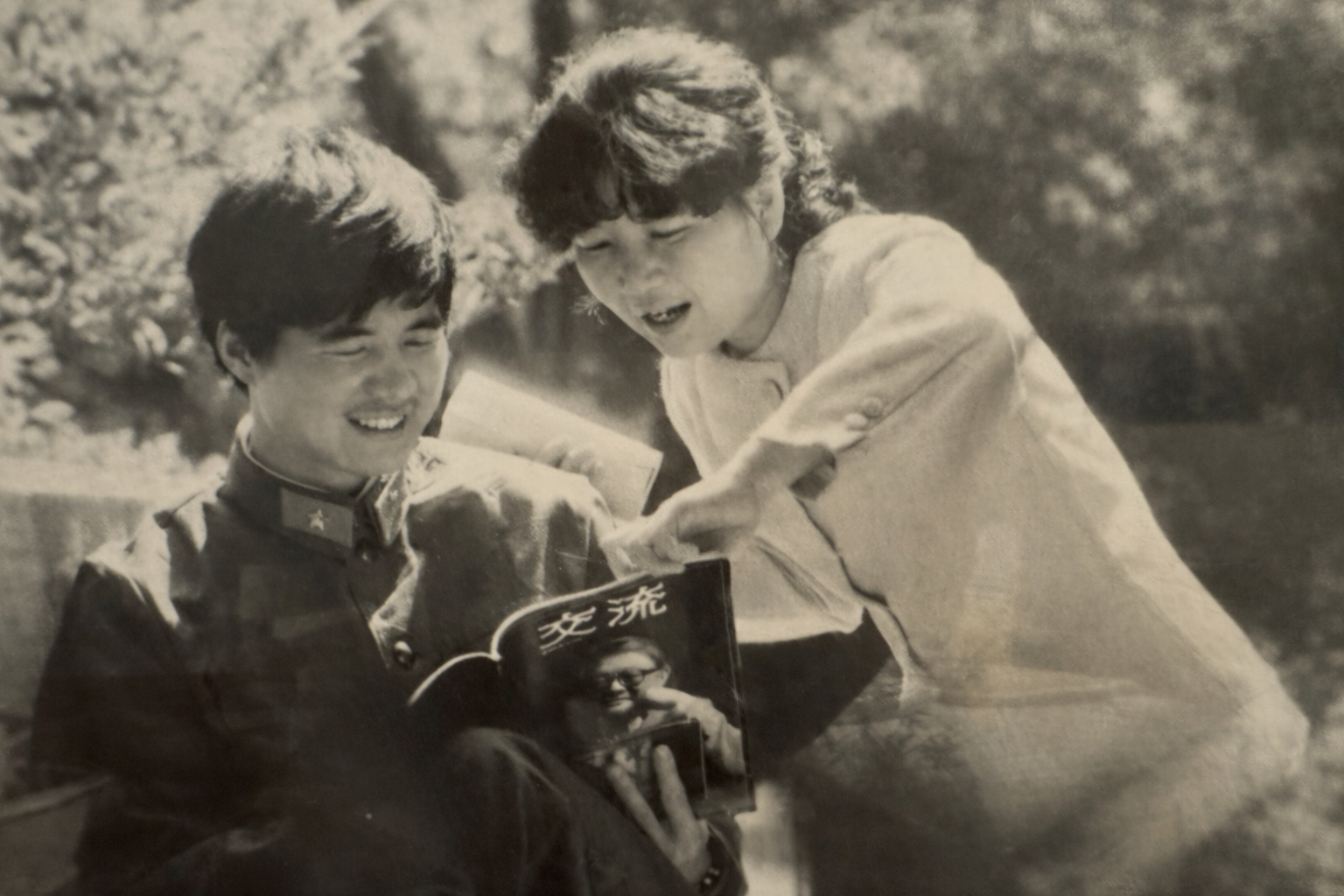
Two years later, without telling either of their families, my parents got married. I’ve asked my father how he proposed and why they got married—were they in love? Did they both want to be married? I wanted to know because I thought it would help me better understand how or why everything fell apart. He didn’t have much of an answer, but I did find an old photograph of the two of them in “wedding” attire, rented from the photography studio they took their picture in, and I formed my own opinions of what went wrong. My mother’s wedding dress had long sleeves and was the faintest, most peculiar shade of green.
A few years into their marriage, my parents were living in Bêijīng when the Tiānānmén Square Massacre (天安门广场大屠) began, in April 1989. My mother was a journalist for the Xīnhuá News Agency, and the office was in a constant upheaval since students were relentlessly protesting and fully occupying Tiānānmén. One night in early June, when her coworkers were discussing whether Tiānānmén Square would be cleared the next day for then-president of Russia, Boris Yeltsin’s visit to China—she decided she wanted to do something to help. She borrowed a large pot from my brother’s kindergarten and made porridge and steamed buns, and my parents then rode a tricycle to deliver food to the protesters in the square, leaving my brother at home alone. She said she felt righteous at the time, but after she spent a night there, her perspective on the student movement changed, and she said it didn’t feel right. The slogans being shouted were chaotic—“We want democracy! We want freedom! We want U.S. dollars!”—she felt she no longer aligned with their views. In her words:
“After that night, I urged the students I encountered to go home, feeling that some of their demands were trivial. I read their petition, which insisted that Premier Li Peng personally accept it; they wouldn’t accept any representatives from his office. I thought the students were being unreasonable. I remember June 5, a Monday; as I walked to the office that morning, I saw overturned buses and beer bottles. The military had cleared the square the night before, and the army vehicles were blocked by the citizens using the buses as barricades.
You can look up news from June 5. Other news agencies reported extensively, while Xīnhuá issued a blank statement. Historically, Xīnhuá had never issued a blank report, but that day, aside from the foreign exchange rate and weather forecast, nothing else was published. That experience was quite interesting. On June 8, I went to apply for my visa and got it smoothly. Perhaps the reality at that time helped me; I obtained the visa to study in the U.S. without taking any exams, exchanged the allowed 84 RMB for U.S. dollars, and embarked on my journey.”
It was August when my mother left China, and my older brother and my father joined her shortly after she settled down. I was born three years later in Reno, Nevada, when my mother was finishing up her master’s degree in political science.
I was about 8 months old when she was accepted into the PhD program at the University of Albany. My parents needed to pack up and drive from Reno to Albany, New York with a toddler, and by adding a newborn baby to the mix when they weren’t sure where they were going to live was too overwhelming. Wàipó and Wàigōng flew to Reno, and I returned to China with them, passed around my extended family like a hot potato. When I was a little over 1 year old, my mom went to China and brought me back to Albany in 1993.
The four of us had the opportunity to finally live happily ever after. My mother was well on her way to earning her PhD, my father was learning English and working as a cook at the local Ramada Inn, bringing home a box of Dunkin’ Donuts every payday, my brother and I were both making friends, and settling in nicely to our new American life.
But it didn’t last for long.
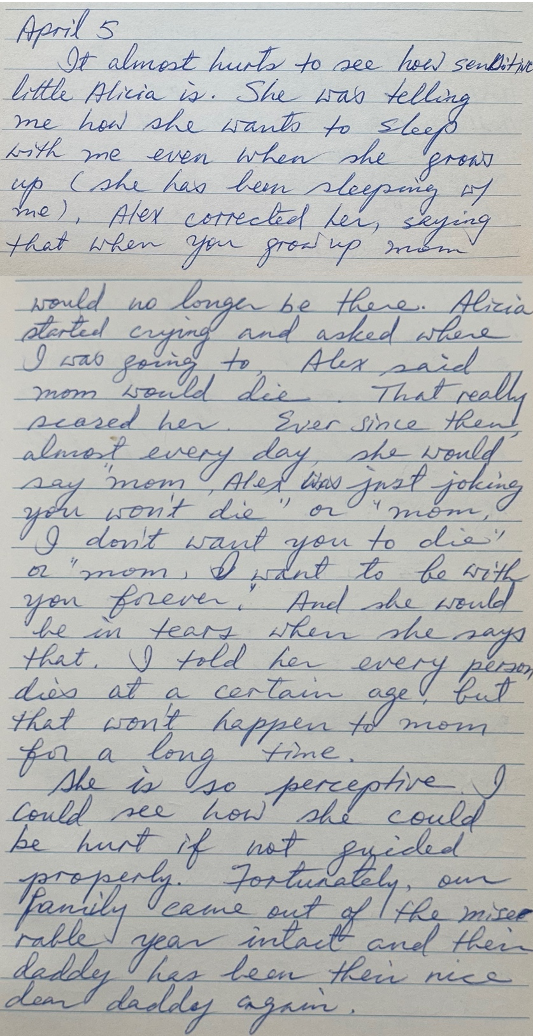
This is from my mother’s journal. In this entry I am 4 years old, and we were living in Albany, NY.