About the Author

Alicia Lou is a Chinese American writer whose work explores identity, cultural dissonance, and the long, wonky path toward healing. Born in Reno and raised between upstate New York, Hong Kong, and Beijing, Alicia brings a deeply personal lens to questions of belonging and self-worth. Her memoir, The Sound a Bird Makes, traces the lasting impact of being left behind at a boarding school in Beijing when she was 7 years old, the alienation she felt growing up between cultures, and her return to China 17 years later—a journey that sparked an emotional reckoning and a renewed connection to her heritage. Woven throughout the book is the story of her mother’s upbringing in China during the Cultural Revolution, offering a glimpse into the country’s complex history and the forces that shaped a generation. By examining her mother’s past alongside her own, Alicia explores why immigrant parents may think and act the way they do, and how love, sacrifice, and survival often manifest in ways that are easily misunderstood.
At a time when public discourse around immigration is increasingly fueled by fear and division, Alicia writes in the hope of shifting the narrative about immigrant families in America. She believes people do not leave their home countries when life is easy, and that the idea that someone who is different is somehow less worthy must be challenged. Through her mother’s story, Alicia hopes to inspire compassion, offering readers a chance to see themselves in a journey of struggle, resilience, and becoming, no matter where they are from.
About the Title
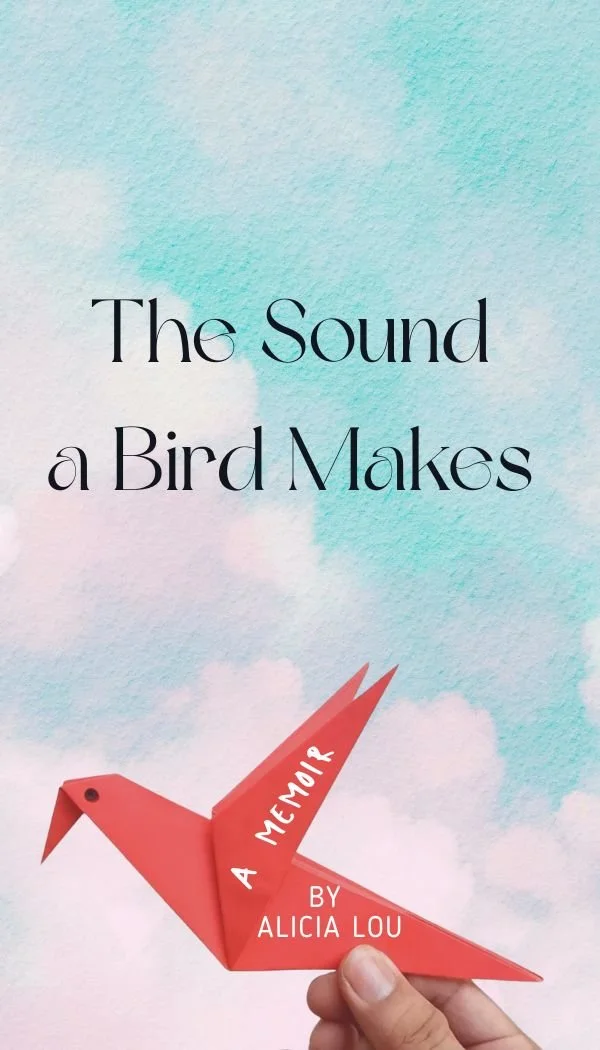
The “sound a bird makes” is derived from my Mandarin Chinese name, 楼一鸣 , specifically the last character “鸣.” There are many complexities in Chinese language, and anyone who is bilingual will understand when I say that many words and phrases simply cannot and should not be translated verbatim, which is both the beauty and downfall of knowing another language.
In Chinese, there can be up to five different tones to pronounce a word: flat; rising; falling and then rising; falling, and neutral, and with every different pronunciation the word can take on a whole new meaning. For example, in Chinese, the word for ‘dew’ is ‘露;’ the word for ‘road’ is ‘路;’ the word for ‘record’ is ‘录,’ and the word for ‘land’ is ‘陆;’ although all four characters are clearly written differently—they are all pronounced the same way—“Lù” with a falling tone.
But something I’ve always been able to appreciate in Chinese writing is how a character is put together. My surname, for example, ‘楼 Lóu’ with a rising tone, translated directly into English, actually means ‘building’—which is why I insist that many things can’t be translated verbatim, as it of course does not mean ‘building’ in the context of my name.
The character ‘楼 Lóu’ is made of three other characters: ‘木,’ the character for ‘wood’ on the left; ‘米,’ the character for ‘rice’ on the top right corner; ‘女’ the character for ‘woman’ on the bottom right. When I was learning how to write ‘楼,’ I was told to remember “a house made of wood where a woman was cooking rice,” which albeit can certainly be perceived as sexist and stereotyping, but it was a nifty way to remember how to write Lóu. ‘一’ is the character for the number ‘one,’ and ‘一鸣’ my given name, is from a Chinese idiom: ‘一鸣惊人’ yī míng jīng rén. It is a metaphor for being average, and to shock and awe others when suddenly making amazing achievements.
However, the character ‘鸣’ on its own is made of two other characters: ‘口’ meaning an opening, or a mouth, and ‘鸟’, which is a bird, and ‘the sound a bird makes’ is how I remembered to write my name.